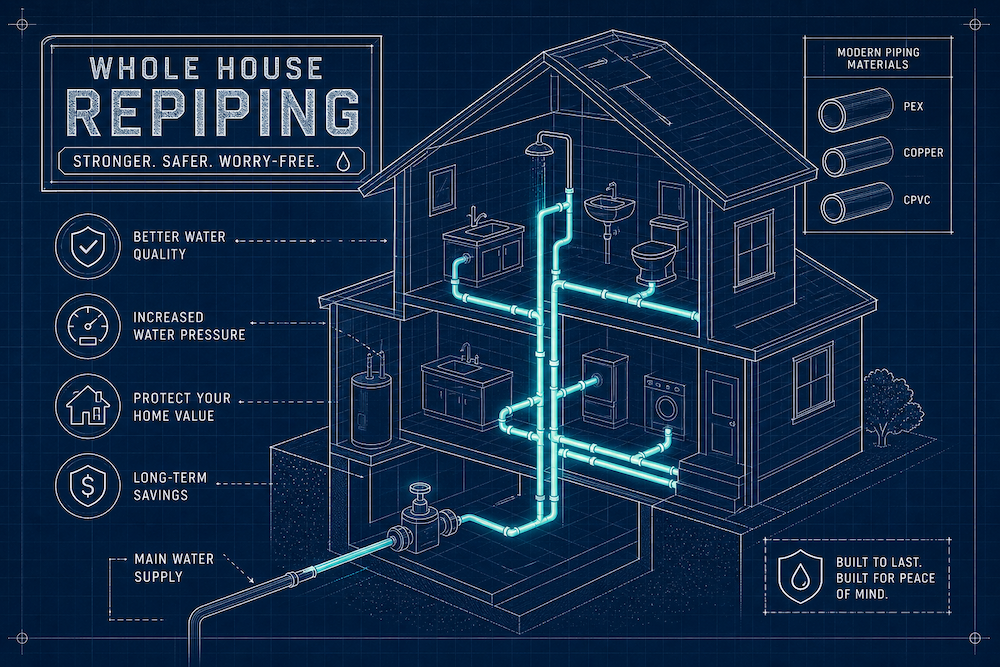
Most homeowners don’t think about their pipes until something forces the issue. A leak behind a wall. Rust-colored water at the kitchen faucet. A home inspection flagging polybutylene or galvanized pipe. If you’ve landed here, a whole house repipe may be on the table, and you need straight answers before you sign anything. This guide gives you those answers without the runaround. By the end, you’ll know whether a full repipe is actually warranted, what the process looks like on the ground, what it should cost in 2026, and what separates a qualified repiping contractor from a generalist who treats your job as a side project.
Signs Your Home Actually Needs a Full Repipe, Not Just a Patch
When the Pipe System Itself Is the Problem
The age and material of your pipes matter more than most homeowners realize. Galvanized steel pipes have a lifespan of roughly 40 to 70 years, but corrosion-related problems often show up well before that. Polybutylene pipe, installed in homes from the late 1970s through the mid-1990s, is a known failure material: chlorinated municipal water degrades it from the inside out, and many systems started leaking within 10 to 20 years of installation. Copper is more durable, it can last 50 years or longer, but older copper systems are still vulnerable to corrosion and pinhole leaks, particularly in homes with aggressive water chemistry or decades of wear. When multiple sections of your pipe system start failing within the same year, that’s not bad luck. That’s a system telling you it’s done.
Water Quality and Pressure Symptoms You Can’t Ignore
Rusty or discolored water, persistent low pressure across multiple fixtures, and water that smells or tastes off are not comfort issues. They’re signs of internal corrosion or mineral buildup narrowing the pipe interior. These symptoms tend to creep up gradually, which makes it easy to adapt to them without realizing how serious the underlying problem has become. If it routinely takes a long time, 30 seconds or more, for water to run clear at the tap, that’s a warning sign worth taking seriously, not something to keep living with.
When a Targeted Repair Actually Makes Sense
One isolated leak in an otherwise sound system doesn’t automatically mean a full repipe. A single damaged fitting or a short section of pipe with a localized problem is a repair situation, not a system replacement. The honest rule of thumb: a one-off, localized problem means repair; repeated, widespread, or age-driven failure means repipe. A contractor worth trusting will tell you the same thing, even when the repipe is the bigger job.
What Whole House Repiping Actually Involves
The Process from Assessment to Water Restoration
A repipe starts with a walkthrough and pipe mapping to plan the new routing. On the first work day, the crew shuts off the water supply and protects floors and belongings before opening wall access points. New pipe is run through walls, ceilings, attics, and crawl spaces, then connected to fixtures and the main supply. Once installation is complete, the system is pressure-tested for leaks before any wall closing begins. The plumbing work is sequential and organized. It’s not chaotic, even when it looks that way from the outside.
What Happens to Your Walls
This is what homeowners fear most, and the honest answer is: some wall opening is unavoidable. Experienced crews work to minimize cuts, but pipes don’t run in open air. Access holes are necessary. Drywall patching may or may not be included in your quote, and that distinction matters. Some contractors handle it directly; others don’t. Clarify this before the contract is signed. Drywall repair typically adds $300 to $2,500 to the total project cost depending on scope. If it’s not spelled out in the quote, expect it to appear on your final bill as a separate charge. For a typical industry breakdown of drywall repair costs, see how much drywall repair costs.
How Long a Whole House Repipe Takes, and What Pushes the Timeline Out
Typical Timelines by Home Size
The estimates below cover plumbing work only. Drywall repair and repainting add additional time on top, and these assume no slab complications are involved.
- Under 1,500 sq ft: 1 to 3 days
- 1,500 to 3,000 sq ft: 3 to 5 days
- 3,000 sq ft and up: 5 to 10 days or more
Factors That Push the Project Longer
Slab work is the biggest timeline variable. If your home has pipes running under the foundation, what’s sometimes called a slab leak repipe situation, rerouting them can add 2 to 4 days to the project on its own. Multi-story homes with complex routing, older homes with inconsistent or deteriorated plumbing, and occupied homes where the crew is working around daily life all extend the schedule. Permit and inspection wait times vary by county: in some parts of Metro Atlanta, inspection scheduling can push a project out by a full week. Build a buffer into your planning. If a contractor promises a hard finish date with no mention of these variables, ask more questions. For a practical look at real-world repipe timelines, read how long a whole-house repipe takes.
What a Whole House Repipe Costs in 2026
Cost to Repipe a House by Size and Pipe Material
The figures below are installed totals, labor, materials, and standard fixture connections, not material-only estimates. Drywall repair is a separate line item unless explicitly included in the quote.
- 1,500 sq ft home: PEX runs $4,500 to $8,500; copper runs $9,000 to $12,000 or more
- 2,500 sq ft home: PEX runs $7,500 to $11,500; copper runs $13,000 to $18,000 or more
- 3,500 sq ft home: PEX runs $9,500 to $15,000; copper runs $16,000 to $24,000 or more
CPVC generally sits between PEX and copper on price. It’s less common than it used to be, but some contractors still use it. For most homeowners, the real decision is PEX versus copper. For a broader national cost overview and examples, see how much it costs to repipe a house.
What Actually Moves the Price
Fixture count matters: more bathrooms mean more connections, and connections take time. Pipe accessibility is the other major driver. A home with a crawl space or open basement costs less to repipe than a slab foundation home where pipes run under concrete. A single-story, 3-bedroom, 2-bath home costs less than a 3-story home of the same square footage because routing complexity increases with each floor. Local labor rates, permit costs, and whether drywall repair is bundled all affect the final number. Ask any contractor about financing options upfront. Reputable companies offer financing to spread the cost of a major system replacement without pushing you into a rushed decision, Greenlee Plumbing is one of them.
PEX vs. Copper: Which Pipe Material Makes Sense for Your Home
The Case for PEX in Most Residential Repipes
PEX costs 30 to 40 percent less than copper installed. It’s flexible, requires fewer fittings, and routes through walls faster, which means less wall damage and less labor time on the job. It also handles freeze conditions better than copper because it can expand slightly without bursting, which matters in North Georgia winters. Many PEX products carry a 25-year warranty and a 25 to 50 year expected lifespan. For most homeowners repiping a 1980s or 1990s home, PEX is the practical, cost-effective choice. The value is real and the performance holds up. For a technical comparison of pros and cons, consult this PEX vs. copper piping guide.
When Copper Is Worth the Higher Cost
Copper has a 50 to 100 year expected lifespan and performs well in high-acid or high-chlorine water chemistry. It’s fully recyclable and non-combustible. If you plan to stay in the home for decades and want the premium long-term option, copper makes a legitimate case. It’s also the right call for any outdoor plumbing runs, since PEX degrades under UV exposure. Bottom line: for most whole house repipes, especially where budget, timeline, and practical performance are the priorities, PEX wins on value. Don’t let anyone upsell you on copper if PEX serves the same purpose at a fraction of the cost.
How to Choose a Repiping Contractor Before You Sign Anything
Questions That Separate Specialists from Generalists
Most plumbing companies handle everything: water heaters, drain cleaning, fixture installs, repipes. Repiping a whole house is a different scope of work, and not every company does it well. Ask directly: how many full repipes have you completed in the past year? Do you pull permits and schedule inspections? Is drywall repair included or subcontracted? Do you carry a written workmanship warranty? A contractor who answers these questions clearly and specifically has done this work before. A contractor who hedges, redirects, or gives vague assurances is a generalist treating your repipe as a side job.
What a Qualified Repiping Contractor Actually Looks Like
A contractor worth hiring brings documented experience in repiping specifically, not just years in the trade. They offer rapid assessment, price transparently before work starts, and back their labor with a written warranty. They pull permits without being asked. They explain what’s included in the quote and what isn’t. Greenlee Plumbing has focused on residential repiping across North Georgia for over two decades, works with both PEX A and PEX B systems depending on the application, and offers financing alongside a written workmanship warranty on every job. Use that as your baseline when you’re comparing bids.
Making the Call
A whole house repipe is a significant investment, but it’s a defined one. You now know the signs that make it necessary, what the process looks like from day one through final inspection, what the cost to repipe a house typically runs in 2026 by size and material, and what a qualified contractor brings to the job. The decision isn’t complicated once you have real information in front of you.
If your pipes are aging, leaking repeatedly, or affecting your water quality, a repipe isn’t something to defer indefinitely. Call it what it is: a system replacement. Not a repair, not a patch, not a band-aid. Get two or three detailed quotes from contractors who specialize in this work, ask the questions listed above, and compare answers as carefully as you compare prices.
If you’re in North Georgia or the Metro Atlanta area, Greenlee Plumbing specializes in exactly this work. Get a free repipe estimate, ask the hard questions, and see how the answers hold up.

Recent Comments