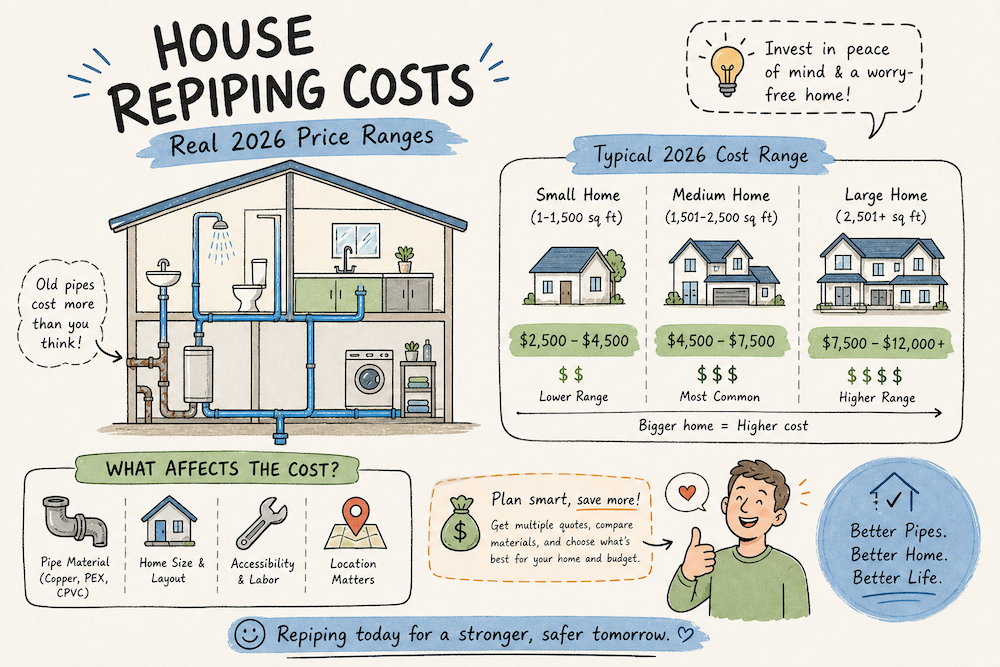
Many homeowners search “house repiping cost,” find a $7,500 average somewhere online, and call it research. Then the actual quote arrives at $12,000 and they feel blindsided. The truth is that $7,500 is a midpoint, not a ceiling. The real national range runs from $1,500 on the low end to well over $15,000 for larger or more complex homes, and the gap between those numbers comes down to four things: pipe material, home size, labor rates, and access conditions. Understanding those four factors before you talk to a contractor is the difference between a productive quote conversation and sticker shock.
At Greenlee Plumbing, we’ve completed whole-house repipes across North Georgia and Metro Atlanta as a family-owned operation, and the most common thing we hear after a first quote is: “I had no idea it involved all of that.” This article is designed to fix that. We’ll walk through every factor that moves the price, give you real numbers by material and home size, flag the hidden costs that most quotes leave off, and tell you exactly what to ask before you sign anything.
What Actually Drives House Repiping Cost
Before the numbers make sense, you need a mental model. Four variables control the price of a whole-house repipe more than anything else: pipe material choice, total footage and fixture count, labor rates in your market, and access conditions inside the home. A lot of homeowners fixate on material cost because it feels like the most controllable variable. The reality is that labor alone typically accounts for 40 to 75 percent of the total bill, which reframes everything.
Plumber labor rates run from $45 to $200 per hour depending on your region and the contractor’s overhead. A whole-house repipe for a standard home requires 60 to 100 labor hours. Run those numbers and you’re looking at $2,700 to $20,000 in labor before a single foot of pipe gets purchased. That’s why two quotes for the same material in the same city can vary by thousands of dollars depending on who’s doing the work and how they’re structured.
How Your Home’s Layout and Age Add to the Bill
A two-story 2,500 sq ft home and a single-story 1,200 sq ft ranch can have wildly different repipe bills even if the pipe material is identical. Many older homes built before the 1990s have legacy materials such as galvanized steel, polybutylene, or deteriorating copper, often with no logical pipe routing. Finished basements, tile walls, and slab foundations all add labor hours because every wall opening requires more planning, more patching, and more time. Slab-on-grade homes, which are common throughout Metro Atlanta and North Georgia, can require concrete cutting to access pipe runs; that alone can add $300 to $6,750 before any new pipe gets installed.
None of these conditions are unusual, and no honest contractor should frame them as surprises. They’re standard scope items once someone walks your home, which is exactly why a proper repipe estimate includes an on-site assessment, not just a square footage calculation.
House Repiping Cost by Material: PEX, Copper, and CPVC
Material selection is where most homeowners spend the most time comparing, but the raw per-foot cost doesn’t tell the full story. Installed cost is what matters, and that number factors in fittings, labor time, and tool requirements. PEX is the current standard for residential repipes for a reason: it’s cheaper per foot, bends without connectors, uses fewer fittings, and installs faster. Copper is durable and carries real resale value in some markets, but the premium is substantial. CPVC is the third option, mostly relevant in older installations or specific regional markets. For a clear technical breakdown of how CPVC, copper, and PEX differ, see the Pro Tool Reviews comparison of CPVC, copper, and PEX.
PEX Piping: Flexible, Affordable, and the Current Standard
PEX pipe material runs $0.50 to $2 per linear foot, and installed whole-house PEX repipes for a standard home typically land in the $4,000 to $8,500 range. In Georgia and Metro Atlanta, a 2,000 sq ft home with PEX commonly runs $8,000 to $12,000 depending on fixture count and access conditions. The installed cost is competitive not just because the material is cheaper, but because PEX requires fewer fittings and can be routed with bends instead of elbows, which cuts labor hours meaningfully.
If you’re comparing quotes that involve PEX, ask whether the contractor is using PEX-A or PEX-B. Based on common trade practice, PEX-A is generally considered more flexible and better suited to freeze conditions, making it the preferred option in most repipe applications. PEX-B is slightly stiffer but still a solid performer and often priced a bit lower. Both are far more practical for whole-house repipes than copper in the current market. If you want a quick guide on whether PEX or CPVC is right for your project, this resource can help clarify the tradeoffs.
Copper: Durable but Expensive in 2026
Copper pipe material runs $2 to $4 per linear foot, and installed copper repipes routinely push into the $9,000 to $20,000-plus range for mid-size homes. A 2,000 sq ft home in Metro Atlanta with copper can run $15,000 to $20,000 or more. The installed cost differential between PEX and copper is roughly 30 to 40 percent in favor of PEX, and that gap is wider today than it was a decade ago as copper prices have climbed.
Copper still makes sense in specific situations: certain local code requirements, homes with water chemistry that’s aggressive toward PEX, or buyers in specific markets who see copper as a premium indicator. If none of those apply to your situation, the price premium for copper is hard to justify on a full repipe.
CPVC: The Budget Rigid Option Worth Knowing
CPVC material costs around $0.57 per linear foot, which puts it in budget territory. The catch is installation: CPVC typically requires solvent welding at every joint and doesn’t bend like PEX, which generally means more fittings and more labor than PEX despite the cheaper pipe cost. It’s less common in modern full-house repipes and more likely to show up in partial repairs or additions to existing CPVC systems. If a contractor is proposing CPVC for a full repipe, ask specifically why they’re recommending it over PEX.
House Repiping Cost by Home Size and Fixture Count
Square footage gives you a rough starting point, but fixture count is actually the better predictor of final cost. More fixtures mean more branch lines, more labor hours, and more wall openings. Use the ranges below to sanity-check any quote you receive. These are realistic 2026 numbers for PEX repipes in a standard-access home without significant slab or foundation complications. If you want a faster ballpark, a repipe cost calculator based on fixture count and square footage can help you narrow the range before you pick up the phone.
Smaller Homes Under 1,500 Sq Ft
Homes under 1,500 sq ft with fewer than 9 to 10 fixtures typically see PEX repipe quotes in the $4,600 to $7,000 range. The job usually wraps in one to two days. A copper installation in the same home pushes closer to $9,000 to $12,000. If a quote for a small home with standard access comes in above $10,000 for PEX, ask for a line-item breakdown before signing.
Mid-Size Homes from 1,500 to 2,500 Sq Ft
This is the most common range for North Georgia homeowners. Expect $6,500 to $11,000 for PEX and $10,000 to $18,000 for copper. Homes with 10 to 14 fixtures generally run $6,300 to $7,800 for PEX, and repipes in the 2,200 to 2,500 sq ft range tend to average near $7,500 based on completed jobs in our market. Two-story layouts, finished basements, and slab foundations all push toward the higher end of these ranges.
Larger Homes and High Fixture Counts
Above 2,500 sq ft with 14 or more fixtures, PEX repipes average $9,000 to $15,000. Copper installations in this range regularly exceed $20,000. Multi-story layouts, extra bathrooms, and slab access requirements all move the number toward the top. If your home is above 3,000 sq ft with multiple full bathrooms and a slab foundation, budget for $12,000 to $15,000 minimum for a PEX repipe before any add-ons are factored in.
Hidden Costs and Add-Ons Most Repipe Quotes Skip
This is where homeowners get hit after the job starts. A repipe quote that doesn’t line-item these costs isn’t a complete quote. Ask about each of these before you sign anything, discovering them mid-project means you’re already committed.
Drywall, Patching, and Paint: The Cost Most People Forget
Plumbers open walls. Someone has to close them, and that someone is often a separate contractor on a separate invoice. Drywall repair runs $2 to $8 per square foot for the full scope: cutting, patching, taping, texturing, and painting. On a full repipe, this can add several hundred to over $2,000 to your final bill depending on how many walls were opened and whether your home has custom texture or specialty finishes. Many plumbing quotes exclude drywall restoration entirely, which means you’ll be calling a separate crew after the plumber wraps up. For current market rates and examples, see the drywall repair cost guide.
Ask every contractor you quote: “Is drywall restoration included, and if not, what’s the estimated restoration cost for this job?” A contractor who’s done enough repipes can give you a realistic ballpark. One who dodges that question is leaving you with an open-ended liability.
Why the Contractor You Hire Changes the Price More Than Most Homeowners Expect
The pipe material and the home size are fixed. The contractor you choose is not. Two contractors quoting the same job with the same materials can come in thousands of dollars apart, and the difference usually isn’t the quality of the work. It’s overhead.
How Contractor Overhead Quietly Inflates Your Quote
Large franchise plumbing operations carry costs that have nothing to do with your pipes: national call centers, marketing budgets, franchise royalties, regional dispatch layers, and corporate management overhead. All of those costs show up somewhere in your quote, usually as a higher base labor rate or vague line items like “project management fees.” Some of the price difference between franchise and independent contractors comes down to those structural costs rather than differences in on-site labor quality. You may be paying for layers of corporate overhead rather than a better-trained plumber at your door.
A family-owned operation typically has less of that structure built into the quote. In many cases, lower overhead can translate to more competitive pricing on the same scope of work, and it often means more transparency on line items, when the owner’s reputation is the business, there’s less room to hide behind vague estimates.
What Transparent Repipe Pricing Actually Looks Like
At Greenlee Plumbing, a repipe quote includes a line-by-line breakdown: pipe material, labor, permits, access work, and any add-ons identified during the site walk. As a family-owned company serving North Georgia, our pricing reflects low overhead and a straightforward approach to quoting. We offer financing, back every job with a 1-year workmanship warranty, and don’t add line items after the work starts that weren’t in the original quote.
That’s the standard you should hold any contractor to, not just us. A complete repipe estimate should tell you exactly what material is being used, how many fixtures are in scope, whether permits are included, what the plan is for wall restoration, and whether slab access has been assessed. If a quote doesn’t answer all of those questions, it’s not a complete quote.
How to Budget Your House Repiping Cost Before Your First Call
You now have enough to walk into any repipe quote conversation prepared. Start with your home size and fixture count to identify a realistic baseline. Add the pipe material premium if you’re considering copper. Factor in drywall restoration as a separate line item. Ask specifically about slab access if your home is slab-on-grade. Confirm permits are included in the quote or at least itemized. And compare quotes based on total scope, not just the headline number. For additional national context on typical repipe costs, see this article on the average cost to repipe a house.
For homeowners in North Georgia and Metro Atlanta, the realistic budget for a standard whole-house repipe with PEX in 2026 is $7,500 to $12,000 for most mid-size homes, with larger or slab-foundation homes pushing toward $15,000 or above before drywall restoration is added. That range reflects real local labor rates and the permit requirements specific to Hall, Gwinnett, Forsyth, and surrounding counties. Use these ranges to estimate your house repiping cost before you call for an on-site quote, it’ll make the conversation more productive and the final number far less surprising.
If your home is in North Georgia or the Metro Atlanta area and you’re ready for an honest, itemized estimate on your whole-house repipe, contact Greenlee Plumbing directly. We’ll walk the property, assess the scope, and hand you a quote that covers every line item before work begins, no surprises after the fact, just a transparent number you can actually budget from.

Recent Comments