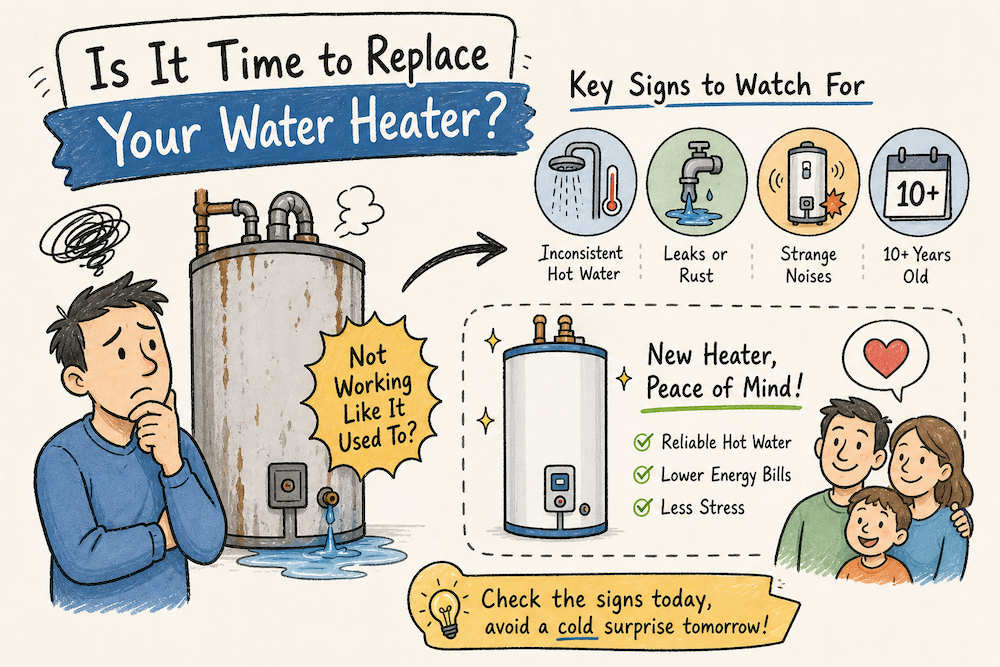
Water heater replacement is a decision most homeowners put off longer than they should. A common pattern in residential plumbing: a homeowner notices warning signs, calls for a repair, pays to patch a dying unit, and then replaces it anyway after the next failure. That cycle costs more money, and sometimes the consequences go beyond money. A failing water heater left too long can mean water damage, mold, or a cold shower at the worst possible moment.
This guide covers what you need to break that cycle. You’ll learn how to read the actual signs that a unit is done, how to run the repair-vs.-replace math correctly, and how to pick the right system for a Georgia home without overthinking it. You’ll also get real 2026 cost numbers and a straightforward way to vet whoever you hire to do the job.
Signs your water heater is actually done, not just struggling
Age is the first thing to check
Standard tank water heaters last about 8 to 12 years. Industry guidance on how long water heaters last. Tankless units run 15 to 20 years with proper maintenance. If your gas or electric tank is past the 10-year mark and showing any symptoms at all, consider replacement your default assumption rather than scheduling another repair. Most manufacturers and consumer organizations recommend planning for hot water heater replacement before failure rather than reacting to it.
Find the serial number on your unit and look up the manufacture date if you’re unsure. Most manufacturers encode the year in the first few characters. Knowing the age changes every other decision you’ll make.
What the unit is telling you physically
Rust-colored or metallic-smelling hot water points to internal corrosion inside the tank. That corrosion is irreversible. Pooling water around the base means the tank itself is leaking, which cannot be repaired. Popping or rumbling sounds come from sediment that has built up on the bottom of the tank over years of use, forcing the heating element to work harder and harder against a layer of mineral buildup.
Visible corrosion on the tank body or on fittings is the most obvious sign. If you can see rust eating through metal on the outside, the inside is already worse. These aren’t maintenance issues. They’re structural failures that no service call will reverse.
When efficiency becomes the symptom
Rising energy bills are the warning sign homeowners ignore longest. Sediment accumulation forces the burner or element to run longer cycles to achieve the same result. Aging heating elements lose capacity gradually, which shows up as lukewarm water during high-demand periods, gradual enough that most households stop registering it as a problem.
If your energy bills have crept up without a clear cause, or if the second person to shower is reliably getting colder water than the first, the unit is telling you something. Patching the symptom rarely addresses the underlying cause.
Water heater replacement vs. repair: how to make the right call
The 50% rule explained
If a repair quote exceeds 50% of the installed cost of a new unit, replacement almost always makes more financial sense. A new tank installed in Georgia typically runs $900 to $1,600. Any repair quote above $600 to $700 on an aging unit deserves serious scrutiny before you approve it.
How age shifts the math
A repair on a 4-year-old heater is usually worth it. The same repair on a 9-year-old tank almost always just delays an inevitable replacement by one or two seasons. You’re essentially paying to extend the life of a unit that’s already past its midpoint. The math doesn’t work in your favor, even if the repair quote looks reasonable at first glance.
When repair is just buying time
Some failure modes cannot be fixed. A leaking tank bottom is a replacement, full stop. Widespread internal corrosion is a replacement. A cracked heat exchanger on a tankless unit is almost always a replacement. Knowing the difference between a repairable component failure and a structural end-of-life condition saves you from paying for a service call on a unit that’s already past saving. Ask the technician directly: is this a component issue, or is the unit itself compromised?
Tank, tankless, or heat pump: what fits a Georgia home
Why tankless works well in the South
Georgia’s climate is favorable for tankless performance. Incoming groundwater temperatures in the Southeast tend to be warmer than in northern states, which means the unit doesn’t have to work as hard to bring water up to temperature on demand. That efficiency advantage compounds over the 15 to 20 year lifespan of a properly maintained tankless unit. The primary trade-off is upfront cost: expect to pay $2,500 to $5,200 installed in this market for a tankless water heater replacement.
When a traditional tank still makes the most sense
Tankless isn’t the right answer for every household. If you have high simultaneous hot water demand, multiple showers running at the same time, or if you simply want a straightforward replacement without electrical or gas line upgrades, a standard tank is a completely rational choice. Installed cost in Georgia runs roughly $900 to $1,600 for a like-for-like swap, reliable hot water without a complex install.
Heat pump water heaters: honest assessment for 2026
Heat pump water heaters can cut water heating energy costs by roughly 50% compared to standard electric tanks, according to U.S. Department of Energy estimates. The federal 25C tax credit that covered up to 30% of costs (capped at $2,000) ended for new installs after December 31, 2025. For details on the 25C credit and how it applied to heat pump water heaters, see the federal 25C tax credit guidance.
Georgia-specific incentives still exist. Georgia Power offers up to $1,000 in rebates for qualifying heat pump water heaters. The Georgia HEAR program provides up to $1,750 for income-eligible households upgrading to a heat pump model. Before assuming any incentive applies, verify your eligibility directly with your utility provider. Program rules, equipment qualification tiers, and contractor participation requirements all affect what you can actually claim.
What water heater replacement actually costs in 2026
Cost ranges by system type
Here are realistic installed cost ranges for the Georgia market in 2026, based on regional pricing data:
- Standard tank: $900 to $1,600
- Tankless: $2,500 to $5,200
- Heat pump: $2,300 to $4,500
These are real-world ranges that reflect the actual cost of the unit plus professional installation. The unit itself is often only half the total. Labor alone on a standard tank swap runs $150 to $450. A tankless install often runs $600 to $1,850 in labor before you account for any additional work. For a detailed national breakdown and local averages, see this water heater replacement cost guide.
What drives installation costs up
The add-ons that inflate quotes are predictable once you know to ask about them. Venting repairs or rerouting on gas units add $300 to $1,000. Gas line upgrades can add $200 to $800 or more. New dedicated electrical circuits for electric or heat pump units run $300 to $1,000 depending on complexity. Expansion tanks, often required under local plumbing code in Georgia jurisdictions, add $90 to $350. Old unit removal typically runs $50 to $150 more.
A standard like-for-like tank swap takes 2 to 4 hours. A tankless conversion, or any install involving venting changes, gas line work, or electrical upgrades, runs 4 to 8 hours. Get an itemized quote that breaks out the unit, labor, and any additional work before you approve anything. Regional cost calculators such as cost to replace a hot water heater tools can help you sanity-check a contractor’s numbers.
Permits and what to expect in Georgia counties
In Hall, Gwinnett, Forsyth, and surrounding counties, water heater replacement requires a permit. Hall County explicitly lists it as permit-required work, submitted through the Accela Citizen Access Portal. Gwinnett and Forsyth generally follow the same Georgia standard: plumbing permit required, final inspection after installation. Confirm current requirements directly with your county’s building department before work begins, as fees and procedures can vary. Permit fees typically run $50 to $400 depending on the county and scope of work.
Confirm with your contractor in writing who is responsible for pulling the permit before any work starts. If a contractor suggests skipping the permit to save money or speed up the project, that’s a contractor you don’t want working on your home. Unpermitted work creates liability problems when you sell, and it means the installation was never inspected for code compliance or safety.
How to choose the right plumber for the job
Questions to ask before you hire anyone
Before you commit to any installer, get clear answers to these questions: Are they licensed and insured in Georgia? Do they pull permits on every job? Do they provide written, upfront pricing before any work starts? What does their workmanship warranty cover, and for how long? Can they complete the job same-day or within a reasonable timeline?
These aren’t unreasonable questions. Any competent, legitimate plumber answers them without hesitation. Vague or evasive answers to basic questions about licensing and warranty coverage are a reliable signal to keep looking.
Red flags that cost homeowners money
Verbal quotes with no written estimate, contractors who frame permit-skipping as a favor to you, and vague answers on what their labor warranty actually covers are all reliable signals to walk away. These patterns almost always lead to disputes, unexpected charges, or installations that fail inspection when you eventually try to sell the house.
Why local expertise matters for hot water heater replacement in North Georgia
Greenlee Plumbing has been handling water heater installations across Hall, Gwinnett, Forsyth, North Fulton, and Cobb Counties for over 20 years. As a family-owned company, they offer same-day replacement, written upfront pricing before any work begins, and a 1-year workmanship warranty on every job. They pull permits, know local code requirements across all five counties, and provide itemized quotes without padding.
Homeowners who want the job done right, documented properly, and backed by a warranty will find that combination harder to get from a generalist plumber who treats water heater work as a side service.
FAQ: Water Heater Replacement, Cost, Timing, and Installer Tips
How do I find water heater installation near me?
Search for licensed plumbers in your county who specialize in residential water heater work. Ask specifically whether they pull permits, provide written quotes, and carry a workmanship warranty. A plumber who handles water heater installation near me searches should be able to confirm same-day or next-day availability and itemize costs before starting.
What is the average water heater replacement cost estimate for Georgia in 2026?
For a standard tank, budget $900 to $1,600 installed. Tankless units run $2,500 to $5,200. Heat pump models fall between $2,300 and $4,500. Get a written water heater replacement cost estimate before approving any work, it should break out the unit, labor, and any add-ons like expansion tanks or venting changes separately.
Make the call before the unit makes it for you
Water heater replacement is a decision most homeowners delay too long, but the signs of failure are rarely subtle once you know what to look for. The repair-vs.-replace math is straightforward. The system choice comes down to your household’s actual usage, your budget, and whether current incentives change the calculus for heat pump models.
Check the age first. Apply the 50% repair rule. Match the system type to how your household actually uses hot water. Confirm that your installer pulls permits and backs their work with a written warranty. Get a free water heater replacement cost estimate before committing to anything.
If your unit is past 10 years or showing any of the signs covered here, a conversation with Greenlee Plumbing costs nothing. Same-day availability and transparent pricing mean there’s no reason to wait until it fails completely. Call before the situation decides for you.

Recent Comments